Showing posts with label humanity. Show all posts

Friday, April 14, 2023

Fiction Can Make Us More Humane

I have been reading recently about how white Americans have slaughtered Natives in gruesome ways, hundreds or thousands of times. This is our white national guilt. We need to face up to this part of our history, even if it makes white people uncomfortable. Here in Oklahoma, it is illegal to teach anything (such as but not limited to history) in such a way as to make anybody (that is, anybody white) feel guilty

One famous example of a white massacre of Natives is the Sand Creek Massacre in southeastern Colorado. Colonel John Chivington attacked a peaceful party of Cheyenne Natives. A former minister, Chivington justified his massacre by saying “Nits make lice.” He hunted down women and children who fled the camp and mutilated them. His soldiers sliced open a pregnant woman. One soldier sliced the pubic hair from a Cheyenne woman, and it was on display in Denver. The next decade, in the Black Hills, whites bought Sioux scalps for up to $300 apiece. (It was as common for whites to scalp Natives as the other way around.) I will not go into more details, partly because they sicken me. You can read about it in Edward Lazarus’ monumental 1991 book, Black Hills White Justice.
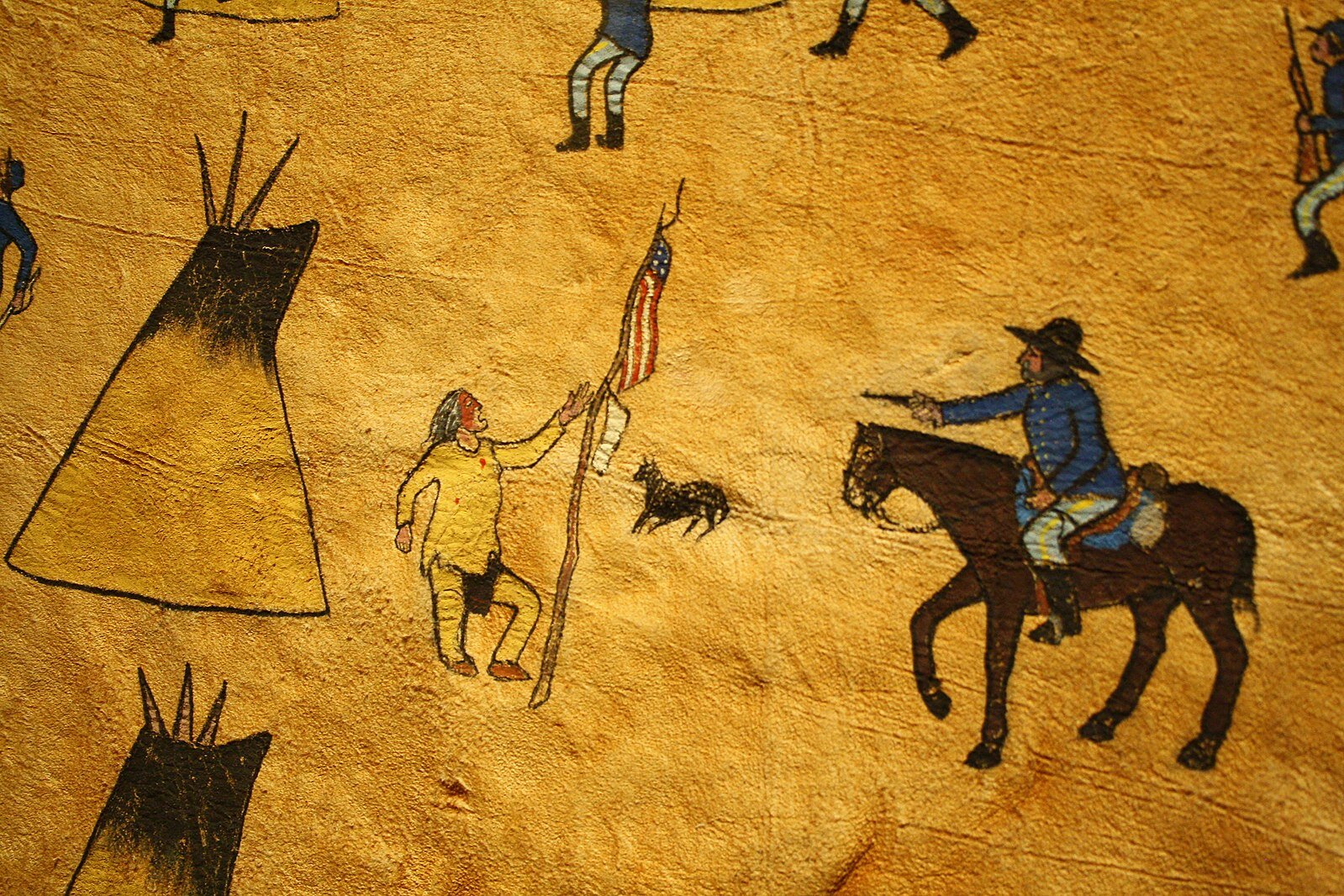
History - Sand Creek Massacre Foundation

This is what happens when powerful men are free to do whatever they please to poor and helpless people. There is no sentiment that can stop them.

At the same time, writers of stories and novels depicted Native Americans as being brave, honorable, noble, and respectful at least to people who were not killing them. An example that comes to mind, of which everyone has heard, is Last of the Mohicans. Painters such as George Catlin lived among them and painted them as real people, with real lives and relationships. While the nineteenth-century fiction about Native Americans seems racist to us today, at the time it stood out as practically the only defense of the humanity of Natives. At the time of the slaughters of Cheyenne and Sioux, “East-river” humanitarians (east of the Missouri River in Dakota Territory) called for peace with, rather than slaughter of, Natives.

Whenever the Natives struck back against the Army that gleefully massacred them, the newspapers (writing what they considered non-fiction) would loudly proclaim the Natives to be savages that deserved extermination. In particular, one editorial proposed a Final Solution for the Natives. He wrote, “It’s high time the sickly sentimentalism about humane treatment and conciliatory measures should be consigned to novel writers. There can be no permanent, lasting peace on the frontier till these devils are exterminated” (emphasis mine). You will find this on page 39 of Lazarus’ book.

This shows how important it is for us writers, especially of fiction, to reveal the humanity of all groups of humans. I mean full humanity, the bad as well as the good. People who read these novels opposed the slaughter of Natives. Without these novels, the humanitarians might have disapproved of the slaughters but would not have felt very much outrage at them. It was not just a matter of legal fairness, good government, or the proper use of human resources. These are human beings we are talking about.

This is an exact Native equivalent of the important role that Uncle Tom’s Cabin played in stirring up the national conscience against slavery.

As a writer, I consider it my responsibility to champion the full humanity and beauty of oppressed peoples.

Friday, August 16, 2019

George Washington Carver and the Scientific Method


This essay and the previous also appeared in my science blog [http://honest-ab.blogspot.com/]. However, I will have a third essay about George Washington Carver that is unique to this blog.

I have recently posted a video on this topic.

At the height of his fame, it was nearly impossible to criticize George Washington Carver (see previous essay). He was famous for his personal dedication to using science as a way of helping non-scientists to improve their economic conditions and open their eyes to the beauty and wonder of the world. During the Depression, when his fame was worldwide (even Mahatma Gandhi corresponded with him), people wanted to hear a story of a man—a really and truly good man—who rose up from slavery to fame.

But he did receive some criticism. When I first read about this, I was shocked, but I then understood the reason for it. An editorial in the New York Times claimed that Carver did not follow the standards of good scientific research. This viewpoint was quickly shouted down by Carver’s admirers. But the critic had a point.

Nearly every active scientist in the world is part of a community, in which each scientist builds on the work of others, so that no scientist has to labor in isolation to discover new truths. For at least a century before Carver, all scientists cited, sometimes at great length, the work of those who came before. The reason was quite practical: by citing the work of others, no scientist has to bear the complete burden of credibility. A scientist could show that, because his work agreed with the known facts of science, it was likely to be true. Even revolutionary scientific insights had to do this. Darwin’s Origin of Species had extensive citations, showing that his truly new insight into science agreed with the known facts of geology and biology.

Carver practiced a form of theistic science that is almost unknown today. He would go into his laboratory (which he called “God’s Little Workshop”) and open his mind to a contemplation of God. He felt that God led him to discover truths that God had secretly put into the natural world and that it was Carver’s privilege to reveal. While many scientists today have this feeling, with Carver it was so strong that he did not read the work of other scientists—he considered his discoveries to come directly from God—nor did he even take notes on his work. Not surprisingly, when any company showed interest in one of Carver’s inventions, they could not invest in it because Carver had no written records that the invention actually worked. And when Carver died, no one knew how to make them. His knowledge died with him.

Incidentally, Carver’s theistic approach also greatly contrasted with that of modern “creation scientists.” Carver entered his laboratory with an open mind for discovery, while modern creationists do their work (usually just recycling the work of other scientists) with the express purpose of demonstrating a specific religious doctrine, such as proving that the universe is young or that evolution is impossible.

I admit this characteristic of Carver’s scientific work. I do not believe that scientists, in general, should work this way. But I revere Carver anyway, for other reasons explained above and in the previous essay. The scientific community is large and diverse enough to include unconventional geniuses like George Washington Carver.