Showing posts with label Four Horsemen of the Apocalypse. Show all posts

Sunday, January 3, 2021

Face to Face with War: The Four Horsemen of the Apocalypse, Part 3

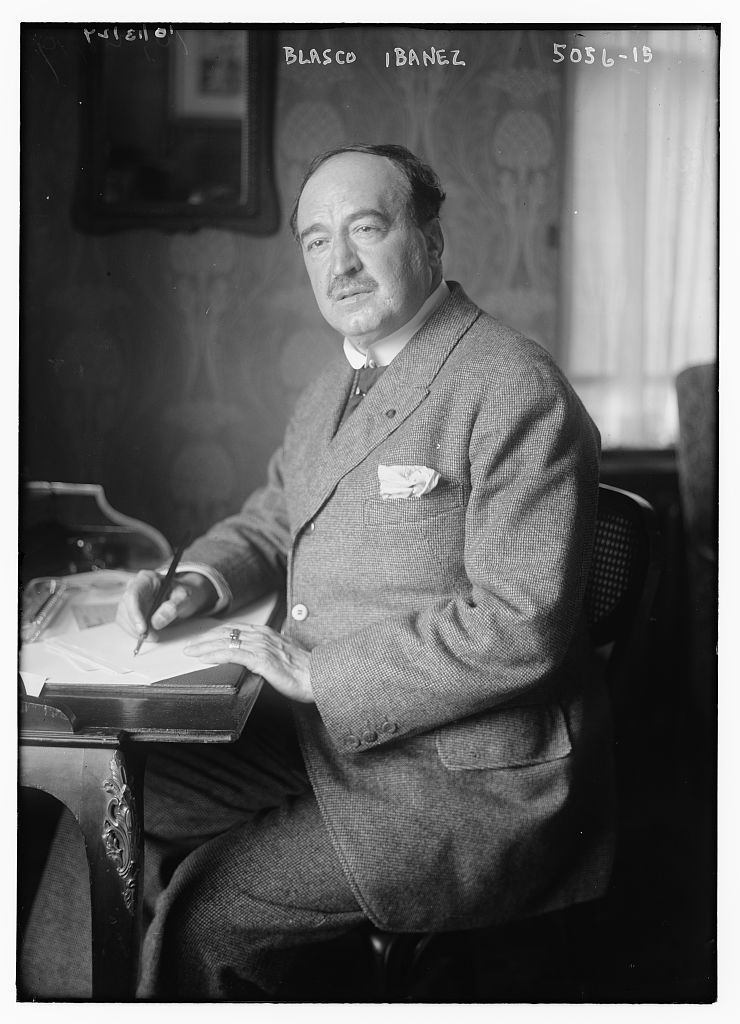
This is the third essay I have written about the novel The Four Horsemen of the Apocalypse by Spanish novelist Vicente Blasco Ibañez. The world in 2021 is no less vulnerable to war than in any previous year, decade, century, or millennium.

I suppose it is about time to describe the novel itself. It is focused on Marcelo Desnoyers, a Frenchman who fled France to avoid being drafted into the Franco-Prussian War of 1870. He earned a fortune in Argentina and returned to France for what he considered to be the pinnacle of cultured life. He bought a big house, and then bought a castle in the country near the Marne River. He filled both places with incredible treasures. His two children were Argentinian citizens. One of them, his son Julio, became well-known in Paris for his dancing and his wasteful lifestyle. In particular, a married woman was his lover.

When the Great War started, Marcelo was too old to fight, and Julio was exempt because he was not a French citizen. The war changed everything for all of them. Marcelo went out to his castle, just in time, it turned out, for the Battle of the Marne. He saw it all from his castle, which the Germans attacked and plundered. The Germans not only slaughtered all of the people they could find in the village near the castle but were also full of arrogance. The German officers feasted on Marcelo’s food, and even dressed themselves in his daughter’s dresses and danced around. They shat upon the rugs. Ibañez vividly describes the scenes, using all of the senses. In the wounded villagers, brains were visible, throbbing behind faces without noses. A cannon ball tore off the head of one soldier, who for just a split second kept walking, with two jets of red blood shooting upward from his neck. Disemboweled horses trampled their own entrails. It was at the greenest time of year, when the wheat was in full grain, the most vivid contrast possible between life and death.

The German officers also pretended to be sincerely good people. They carried photos of their beloved families and proclaimed that only by destroying France would their families be able to live. This was an incredible lie but one that, Ibañez suggested, the Germans actually believed. They recognized Marcelo as the castle owner, and instead of just shooting him they tried to convince him of the righteousness of their cause.

But the Germans were beaten back. During their retreat, they transformed the ruined castle into a military hospital. Here Marcelo watched some of the very officers who had so recently boasted of their inevitable victory return, mangled almost beyond recognition, and die. When the French army returned, the Germans fled.

Northern France began to recover. But life for the Desnoyers family changed forever. Julio’s lover, feeling guilty at cuckolding her husband, found that the husband had become a military hero as he was wounded in battle. She sought him out, stayed by his side, and nursed him back to health. Julio, heartbroken, felt that he could do only one thing: join the French army as a foreign volunteer. He did so and became a hero himself. His motivation was not patriotism so much as it was forlorn love, and to just do something with his life rather than just to enjoy his wealth. His father Marcelo, who every day felt the guilt at having fled his patriotic duty in 1870, was now intensely proud of his son.

As you can certainly guess, Julio was killed in battle. The story ends, after almost 500 pages, with Marcelo and his family feeling almost infinite grief out in the middle of the burial fields, months after the battle was over. The bodies of slaughtered French soldiers had been piled up and their burial places marked only with little wooden crosses. The bodies of the German soldiers were piled in unmarked pits and covered with dirt.

The scale of the burial fields is nearly impossible to imagine apart from Ibañez’s description. I got only a tiny glimpse of what it must have been like when I hiked with my son-in-law’s family in the Vosges Mountains that divide Alsace and Lorraine in France in 2016. We went quickly past a World War One cemetery. The French family had seen it, and dozens of others, scattered throughout the mountains, but for me it was a powerful experience.


To a large extent, The Four Horsemen of the Apocalypse was a story that wove together improbable circumstances in order to give the author, who was a journalist with first-hand experience, the excuse to write about the ideas that led to the war. How likely would it be that the sister of Marcelo’s wife would just happen to marry a German who became a top official in the evil German government, and explained his point of view to the rest of the family in great detail? How likely that Julio and later Marcelo should befriend a Russian socialist living in Paris, who explained his point of view in great detail? He said that the supposed Christianity of the Germans was actually the worship of Thor rather than of Jesus. It was the atheist socialist, not the German Christians, who believed that “blessed are the peacemakers.” But the characters were not simply excuses for ideas; they were, to me, vividly real.

And was it not all ultimately futile? Ibañez wrote, through the mind of Marcelo, “I wonder if any star knows that Bismarck ever existed! I wonder if the plants are aware of the divine mission of the German nation!” But I wonder if Ibañez would have been able to guess that, a hundred years later, the European Union, led by France and Germany, would get the Nobel Peace Prize?

But hope remains defiant. At the very end, Marcelo’s daughter hugged her fiancé, a wounded hero, right out in the middle of the burial fields—love may not triumph over, but it remains defiant against, death.

Monday, December 28, 2020

Just How Strong Is Altruism? The Four Horsemen of the Apocalypse, part 2

In my columns and books, I have written extensively about altruism. Altruism is doing well by doing good. It is what happens when one animal is good to another animal in the same species. Altruism has been studied extensively by evolutionary scientists, not only via mathematical theory, but with lots and lots of examples from the animal, including the human, world. Altruism occurs because, very often, the best way for an animal to pass its genes on to the next generation (which is what natural selection is all about) is to cooperate with other animals. It often pays to be good. Not only that, but natural selection has favored many positive emotions to encourage altruism: it feels good to be good.

But in order for altruism to work, there has to be a dividing line between the inside and the outside of the group in which altruism occurs. Natural selection may favor altruism inside the group, but favors behavior that is merciless, and feelings of hatred, outside of the group. An undeniable trend of human history has been the uneven and gradual extension of the dividing line, so that we incorporate more and more people as insiders. A lot of us include the whole world, even the non-human world, in our inside group, or at least we think we do. The question, therefore, is not whether altruism is beneficial or even possible, but how common is it? That is, altruism is part of human nature, but so is brutality. Is human nature good, or bad? I believed that it is both. One of my students, however, drew upon his military experience, in which he was traumatized by what he saw in Bosnia and Afghanistan, to say that human nature is evil. I thought he was wrong. Now I’m not so sure. After reading The Four Horsemen, I wonder whether altruism might be fragile and might even go extinct in our world of the immediate future. Are, as Ibañez said, the Four Horsemen the reality of the world?


For those of you who may not know, The Apocalypse is the Book of Revelation, the last book of the Christian Bible, in which a man named John described a vision. In just part of this vision, he saw four supernatural horsemen. One was war, another was disease, another was famine, another was death. Can altruism really keep these metaphorical horsemen from galloping around the world? Or is the world actually theirs? I’m no longer sure.

Ibañez envisioned the Four Horseman galloping freely over the Earth. In one scene, Ibañez described an apartment in Paris in which a Frenchman was married to a German woman. As soon as the war began, the Frenchman went off to kill Germans. He did not consider his wife to be part of the hated outside group, despite her nationality. But she felt the guilt of knowing that she was a German surrounded by the French who did not deserve to be attacked by her people. She jumped off her porch and died in the plaza. It was the Four Horsemen, said Ibañez, who pushed her.

A French servant woman, having seen the devastation of war, said something that might summarize the thoughts above: “God has forgotten the world.”

Monday, December 21, 2020

Who Is to Blame for War? The Four Horsemen of the Apocalypse (novel), part 1.

As humans culturally evolve to a point of greater knowledge and understanding, one would expect war to become obsolete. There is probably nothing that war can accomplish that cannot be accomplished better through less violent means. But nations, unlike some individuals, have almost never been known to resolve conflicts peacefully. When they do, it is a cause for celebration; the European Union got the 2012 Nobel Peace Prize for simply not having war for six decades.

But wars are not just things that happen. Somebody has to start them. I thought about this as I read, in English translation, the classic novel about World War One: The Four Horsemen of the Apocalypse, by Vicente Blasco Ibañez, written in 1916 even before the war was over. I will tell a little about this novel in a later essay.


Seldom are wars started solely by ordinary people who may want to take resources from, or who feel animosity toward, people of other countries. War is started by governments, who then stir up masses of ordinary people into a frenzy of patriotism, fueled by religion. And, sometimes, fueled by something else as well: scientists and other intellectuals. As a scientist, I hate to admit this, but…well, let me give you an example.

The war that is now called World War One (The Great War, prior to the second) was a war that, as it happened, and even a century after it ended, has been hard to explain. Ask anybody what caused World War Two, and they will say Hitler and Mussolini and the imperialists of Japan. But World War One? Most people would guess Germany—and that is the correct answer—but that is about as far as they could go. I didn’t know much more about it than this before I began reading the novel.

Germany started World War One. It arose from the unresolved animosity from the Franco-Prussian War. In 1870, Prussia insisted that it had the right to rule France. The German Prussians had to retreat from France, except for Alsace. Then, in the Great War, the Germans attacked France again. This time the Allies beat them back past Alsace, to the east of the Rhine River. Then they did it again. Full resolution did not happen until Germany’s unconditional surrender after World War Two. Since that time, peace has been maintained in most of Europe.

German aggression did not result simply from economic and military leaders ordering German troops to attack France (as well as Belgium and other countries). The German people (not all of them, but millions of them) believed with all their souls that Germans were the master race and deserved to rule as much territory as they could get, by whatever means they could get it. They believed whole-heartedly in the war, and the German soldiers fought ferociously. According to Ibañez, German soldiers killed anyone they could find in Belgium, even cutting off women’s breasts and nailing them to doors, or spiking babies on bayonets and parading them around town. Only religion—in this case, a religion of German superiority—can so strongly parasitize the human mind as to make people believe and do things like this.

The Germans began World War One with the claim that the war would be brief and intense. They claimed that by beating down the other countries, particularly France, with utter ferocity, they would make it impossible for any European war to ever occur again. They thought of it as the war that would rid the world of future wars. This was their justification for utter, and often insane, brutality. According to Ibañez, the Germans said that cruelty was actually kindness. Cruelty would force an earlier surrender and an earlier end to the sufferings. It was necessary to kill even the children because, if left behind, the children would grow up as Frenchmen who did not worship the power and glory of Germany.

Who stirred up the Germans to such an intensity of evil? The government and military leaders deserved most of the blame. Religion, far from engendering careful humanitarian thought, became just a rallying point for bloodthirstiness. Ibañez said that, to the Germans, “outside of Germany everything was despicable, even their own religion.” That is, the Germans were proud of their Christianity but hated that of the French. He also said that one of the kinds of people who vanished during the war was the man “of complex spirituality,” whose beliefs could not be summarized by a flag.

At this point in history, Germans considered themselves the most civilized people on Earth. Theirs was, they believed, the greatest music and the greatest art. And they fancied themselves to be the leaders of the intellectual world. Ibañez makes it perfectly clear that German scholars created a framework of intellectual justification for the brutality. Ernst Haeckel, the biologist, claimed to be inspired by Darwin. Actually, Haeckel took most of his inspiration from the Englishman Herbert Spencer, who believed that Darwinism proved the superiority of the white race. Haeckel substituted German for white. The German intellectuals had prepared the way for the war, giving it a “varnish of scientific justification,” in the words of Ibañez.

As I am an intellectual, this sent a chill down my spine. The words that I write in my books and blogs, and the things that I teach in my classes, might be ignored by most people. But, even if I do not intend it, some of my words might take on a life of their own and become a scourge to history. Those of us who have the holy duty of seeking and telling the scientific truth about the world need to be proactive, and always frame our statements in a context of humanitarianism, even of love.

I will next post an essay about The Four Horsemen and altruism.