Christian responses to the environment can be roughly classified on the basis of what a person considers the environment to be: creation, or nature. The first considers the environment and all of its living and nonliving components to be the product of a deity that has made humankind separate from it in some way, while the second considers the environment to be the source of humankind (“nature” comes from the Latin for “birth”). First, in this installment, let us consider the approach that considers the environment to be creation.
The major monotheistic religions of the world (Judaism, Christianity, and Islam) believe that a single, all-powerful deity created the world and made humans the rulers of it. Moreover, these religions base their beliefs upon scriptures written long before people even imagined the questions of environmental ethics. Until the last few centuries, humans quite rightly viewed the Earth as unconquerable and usually dangerous. The Earth could take care of itself. Modern adherents of these religions therefore turn to their pre-ecological scriptures and pick out passages that were not written for the purpose of answering such questions and try to base systems of environmental ethics upon them, concluding that the environment is expendable.
Because of the importance of the Judeo-Christian Bible in the history of western culture, historian Lynn White, Jr. wrote in 1967 that Christianity, guided by the first chapter of Genesis, had been in the forefront of a largely successful attempt to conquer the created world. It is beyond dispute that, according to this chapter, God gives humans the command to conquer and subdue the Earth and have dominion over it. The words clearly refer to the kind of conquest that kings exercised over vanquished nations. White did not, however, say that Christianity should be rejected, but that Christians should use Saint Francis of Assisi, a medieval Italian monk who considered the Sun, Moon, wind, fire, and all creatures to be his brothers and sisters, as the model of ethical behavior rather than the Bible.
Not surprisingly, many Christians became defensive and claimed that White had misinterpreted the first chapter of Genesis. Since 1967, Christian writers have found many passages in the Bible that paint a very different picture of the creation. Here are a few examples:
• The second chapter of Genesis depicts God as commanding humans to take care of the Earth the way one would care for a garden (the Garden of Eden).
• The third chapter of Genesis depicts expulsion from the Garden of Eden, and a host of environmental problems (“cursed is the ground…thorns and thistles it shall bring forth”) as consequences of sin.
• The sixth chapter of Genesis describes Noah, whose family was to be the sole survivors of a worldwide flood. God old Noah to build an ark big enough for a pair of each species of terrestrial animal, presumably even those that Noah did not especially care about.
• The Ten Commandments included a prohibition against work on one day of the week, called the sabbath. The result of this commandment, according to conservative Jewish scholars, is the deliberate interruption of the momentum of acquisition—to desist, once a week, from using other people (and the Earth) as a source of profit.
• The Old Testament law included some commandments that dealt directly with the Earth. Most famous is the Sabbath of the Fields, in which agricultural fields were supposed to be left fallow every seventh year.
• In the book of Job, God addresses Job from a whirlwind, and describes a vast unknowable and unconquerable world of creatures, from large ones such as Behemoth and Leviathan to humble ones such as donkeys and conies. The message is clear that the purposes of these creatures have absolutely nothing to do with humans. The fact that these creatures are untamed was a perfectly acceptable part of God’s order of the world.
• Many passages in the psalms and prophets describe the beauty of creation entirely apart from any benefit it may confer on humans. A passage from the prophet Isaiah describes trees reclaiming wasteland and restoring its water resources, and claims that this process, which would now be called ecological, was the work of God.
• Jesus frequently used symbolism from the creation, from wildflowers to sparrows, in his parables—frequently things that would be noticed only by people who stopped to carefully observe them.
Ecology-minded Christians, who focus attention on these passages, claim that God has given humans the responsibility to be stewards, or caretakers, of the Earth, rather than its conquerors. This is an important concept, even though the terms steward and caretaker do not appear in the Bible in connection with the Earth.
This essay is based on the entry “Environmental ethics” in my forthcoming Encyclopedia of Biodiversity.
Friday, August 26, 2011

Monday, August 22, 2011
Do Conservatives Hate Altruism?
On August 16, billionaire Warren Buffett announced his belief that rich people, such as himself, should pay higher taxes than they currently do. This was a direct statement of altruism. He was almost immediately attacked by Republican presidential candidate Michele Bachmann , who said in a loud sarcastic manner, “I have a suggestion. Mr. Buffett, write a big check today. There’s nothing you have to wait for. As a matter of fact the president has redefined millionaires and billionaires as any company that makes over $200,000 a year. That’s his definition of a millionaire and billionaire. So perhaps Mr. Buffett would like to give away his entire fortune above $200,000. That’s what you want to do? Have at it. Give it to the federal government.”
Not surprisingly, Bachmann was wildly inaccurate. The president does not want people to earn only $200,000; he just wants slightly higher tax rates on people earning more than $200,000.
What Bachmann did not say, but clearly implied, was “Sucker.” Any rich like Buffett who would actually want to pay more taxes to help his fellow citizens must clearly be a sucker.
In encounters between animals of the same species, there are cooperators and there are defectors. Whenever a cooperator encounters a defector, the cooperator loses (becomes a sucker) and the defector wins. It would seem inevitable, in a world that consisted only of simple and direct interactions, the defectors always win, even though they cause themselves to become extinct. The world, however, is not that simple. Intelligent animals such as humans can recognize and remember one another as individuals, and they can remember the bad reputations of defectors and the good reputations of cooperators. In a world of complex interactions, cooperators can work together and drive the defectors into obscurity. In ways such as this, altruism (animals being nice to each other even if they incur a cost) can evolve.
Republicans clearly hate altruism. Some hate it more than others. Mitt Romney and Rick Perry do not make statements as extreme as those of Bachmann. It seems inconceivable to extremists like Bachmann that citizens should ever want to help each other. The Tea Party tirade of anger is not so much against “big government” as it is against a societal expectation that we, as fellow citizens, should be expected to help one another out, and that government should be a mechanism to facilitate altruism.
This conclusion is obvious not just from Bachmann’s statement, but from statements by the founding mind of modern extremist conservatism, Ayn Rand. She wrote, “If any civilization is to survive, it is the morality of altruism that men have to reject.” She was as wrong as anyone could be about anything, and so are her modern disciples. Humans are the most altruistic species, and the most successful, in evolutionary terms. Our survival cannot be assured if the Republicans succeed in destroying altruism.
And the extreme conservatives use the Bible to justify their hatred of altruism. Of course, they have to ignore large parts of it, all that stuff that Jesus said about love. They have to rip, rip, rip the Bible apart until there is almost nothing left except the accounts of Joshua killing all of the Canaanites, and God punishing him if he ever spared any of them, and, of course, the Book of Revelation. I suspect that millions of fundamentalist Christians have read the Left Behind series but not the Bible, except for selected bits fed to them by their angry preachers.
For the love of God, we have to stop these crazy fundamentalists.
Don’t wait for an apology or clarification from Bachmann. This is not the first time she has suck all eight of her feet in her mouth.
Not surprisingly, Bachmann was wildly inaccurate. The president does not want people to earn only $200,000; he just wants slightly higher tax rates on people earning more than $200,000.
What Bachmann did not say, but clearly implied, was “Sucker.” Any rich like Buffett who would actually want to pay more taxes to help his fellow citizens must clearly be a sucker.
In encounters between animals of the same species, there are cooperators and there are defectors. Whenever a cooperator encounters a defector, the cooperator loses (becomes a sucker) and the defector wins. It would seem inevitable, in a world that consisted only of simple and direct interactions, the defectors always win, even though they cause themselves to become extinct. The world, however, is not that simple. Intelligent animals such as humans can recognize and remember one another as individuals, and they can remember the bad reputations of defectors and the good reputations of cooperators. In a world of complex interactions, cooperators can work together and drive the defectors into obscurity. In ways such as this, altruism (animals being nice to each other even if they incur a cost) can evolve.
Republicans clearly hate altruism. Some hate it more than others. Mitt Romney and Rick Perry do not make statements as extreme as those of Bachmann. It seems inconceivable to extremists like Bachmann that citizens should ever want to help each other. The Tea Party tirade of anger is not so much against “big government” as it is against a societal expectation that we, as fellow citizens, should be expected to help one another out, and that government should be a mechanism to facilitate altruism.
This conclusion is obvious not just from Bachmann’s statement, but from statements by the founding mind of modern extremist conservatism, Ayn Rand. She wrote, “If any civilization is to survive, it is the morality of altruism that men have to reject.” She was as wrong as anyone could be about anything, and so are her modern disciples. Humans are the most altruistic species, and the most successful, in evolutionary terms. Our survival cannot be assured if the Republicans succeed in destroying altruism.
And the extreme conservatives use the Bible to justify their hatred of altruism. Of course, they have to ignore large parts of it, all that stuff that Jesus said about love. They have to rip, rip, rip the Bible apart until there is almost nothing left except the accounts of Joshua killing all of the Canaanites, and God punishing him if he ever spared any of them, and, of course, the Book of Revelation. I suspect that millions of fundamentalist Christians have read the Left Behind series but not the Bible, except for selected bits fed to them by their angry preachers.
For the love of God, we have to stop these crazy fundamentalists.
Don’t wait for an apology or clarification from Bachmann. This is not the first time she has suck all eight of her feet in her mouth.
Friday, August 12, 2011
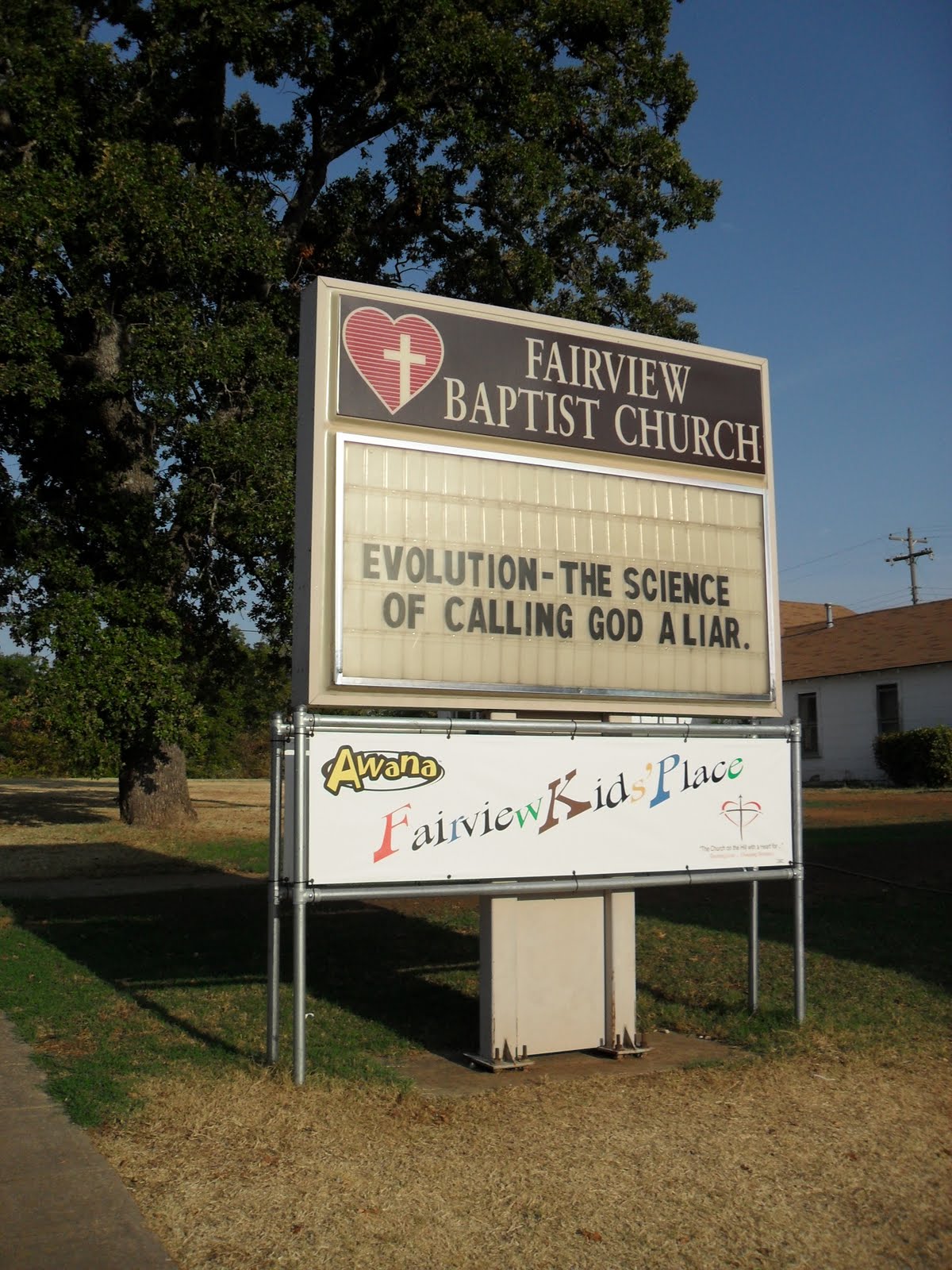
A church marquee in Durant, Oklahoma proclaims that people like me, who teach evolution, are calling God a liar. Well, if that is so, then I better watch out. But of course that is not what I am doing. I am just saying that fundamentalists are wrong about how to interpret the Bible. But apparently these fundamentalists believe that if you or I disagree with them about how they interpret the Bible, then we are obviously disagreeing with God Himself. They think that they are as personally inerrant as God himself. I think that they, who place themselves equal to God, are the ones who should be worried about God's wrath, if there is any such thing.
See this YouTube video for Darwin's response!
See this YouTube video for Darwin's response!
Monday, August 1, 2011
What is Love? Don’t Read the Book of Revelation
What is love? Any Christian will tell you without hesitation that it is defined in the 13th chapter of the first letter of Paul to the church at Corinth. This is, indeed, a beautiful passage. By the way, Biblical scholars pretty much agree that I Corinthians (unlike some other New Testament epistles) was genuinely written by the Apostle Paul. And Jesus demonstrated love all the time—he was sensitive to the touch of a suffering woman, and he saved the life of another woman who was about to be stoned to death for something that a man did to her. The Apostle John said, God is love.
But if you read the book of Revelation, you will get a completely different picture. This is yet another reason that I consider Revelation, and the conservative Christians who swear devotion to it, to be so dangerous. As I explained in a previous entry, most of the book of Revelation is just one long series of plagues and woes, bringing destruction upon the Earth and unspeakable suffering on human beings.
I noticed an interesting thing about those plagues and sufferings. On at least two occasions, the writer said that, despite the sufferings, the people of the Earth did not repent and love God. So God sends another plague. In the end, it does not work, and God establishes his Heavenly City by force, populated apparently only by the 144,000 people who have never had sex.
Imagine, if you will, a man who beats his wife and children, insisting that they love him. When they do not, he beats them some more. Finally they are dead. I think we would all agree that this man (who sounds like some of the rednecks who live around me in Oklahoma, except that they seldom go as far as murder) has no clue about what love is, and is probably crazy. Well, this is exactly what God does to the human race in Revelation. Revelation makes God sound like a crazy maniac. Most religious people do not believe that this is what God is like, but it is the image that Revelation presents. It presents the image of a God who keeps kicking the shit out of the human race until we love him. And this is why Revelation is a dangerous book, and the conservative Christians who adhere to it are dangerous people. I have no problem with Christians who adhere to Jesus rather than to Revelation.
I will be exploring this idea in a new book, Last Tree Standing, which I will write when current publishing and other obligations allow me some time. Please share with me some of your insights.
But if you read the book of Revelation, you will get a completely different picture. This is yet another reason that I consider Revelation, and the conservative Christians who swear devotion to it, to be so dangerous. As I explained in a previous entry, most of the book of Revelation is just one long series of plagues and woes, bringing destruction upon the Earth and unspeakable suffering on human beings.
I noticed an interesting thing about those plagues and sufferings. On at least two occasions, the writer said that, despite the sufferings, the people of the Earth did not repent and love God. So God sends another plague. In the end, it does not work, and God establishes his Heavenly City by force, populated apparently only by the 144,000 people who have never had sex.
Imagine, if you will, a man who beats his wife and children, insisting that they love him. When they do not, he beats them some more. Finally they are dead. I think we would all agree that this man (who sounds like some of the rednecks who live around me in Oklahoma, except that they seldom go as far as murder) has no clue about what love is, and is probably crazy. Well, this is exactly what God does to the human race in Revelation. Revelation makes God sound like a crazy maniac. Most religious people do not believe that this is what God is like, but it is the image that Revelation presents. It presents the image of a God who keeps kicking the shit out of the human race until we love him. And this is why Revelation is a dangerous book, and the conservative Christians who adhere to it are dangerous people. I have no problem with Christians who adhere to Jesus rather than to Revelation.
I will be exploring this idea in a new book, Last Tree Standing, which I will write when current publishing and other obligations allow me some time. Please share with me some of your insights.
Saturday, July 23, 2011
How Christianity is Destroying the Earth
The topic of why Christianity is wrong is of no mere academic interest. It is perhaps the most important topic in the world today. The majority of people in the United States adhere to a form of Christianity that leads, consciously and unconsciously, to the destruction of the Earth. And the United States is the leading consumer in the world; if we act destructively toward the Earth, it will be destroyed, and no bleeding-heart environmentalists in Norway can stop it.
I realized this as I began to read Bart Ehrman’s book from eight years ago—Lost Christianities. Ehrman is an excellent Biblical scholar, but I am an evolutionary scientist, so I read the first part of his book with different eyes than he used while writing it. I saw the evolution of Christianity as an example of cultural evolution—in particular, of one branch of Christianity that forced other branches into extinction, often violently, by decreeing them to be heretics. “Orthodox” Christianity suppressed the other branches, sometimes completely into extinction, but otherwise into such obscurity that only the luckiest of archaeological finds have revealed them. This is what happened when the church stopped being a haven for women and slaves and started turning into a political force with a hierarchy.
The “orthodox” Christianity that prevailed got to dictate which books would be in the Bible. There are lots of other gospels, epistles, acts, and apocalypses that they tried to destroy. But one of the books that they made sure was in the Bible was Revelation, written by somebody named John, whom most churchgoers assume was the Apostle John, though the author nowhere claims this to be the case.
It had been awhile since I had looked at Revelation, though I have read it carefully twice. Those previous times, however, I read it through the eyes of faith, assuming it to be divine revelation. This time I could see it for what it really was. Previously, I had tried my hardest to interpret it in a loving fashion. But now I could see the hatred that seethes from it. In a later entry, I will summarize it. But for now I just point out that it—presented in the form of a vision—is actually a nightmare of blood and gore and hatred. The author must have gotten some bad hash from Damascus.
First, you will not recognize the Jesus who is in Revelation. He is a conqueror, with a sword coming out of his mouth, and making the earth to apparently flow fathoms deep in human blood. Second, you will not recognize God the Creator of the Good Green Earth. Every few verses there is another disaster, both human and ecological—the Earth seems to get destroyed about fifteen times in that book. If one green sprig survives, it is sure to get pummeled and poisoned a few verses later. The disasters are concatenated: as soon as you think it is about over, another series erupts—within the Seventh Seal were seven trumpets, but within the seventh trumpet were three protracted woes, within which were crammed seven plagues. And so on. A cavalry of 200 million supernatural horses. People believe this stuff.
And at the end, when there is supposedly a heavenly city that takes over all of the universe, what do you have? A city consisting entirely of gold and jewels. The animals in that world are creepy monstrosities that look like Dr. Moreau invented them. And there is one tree—just one—left standing. This is the conservative Christian view of eternity—one in which everything that they claim God created has been destroyed and replaced with a total artificiality. You can bet your bottom ribosome that the “glassy sea” has no phytoplankton in it.
That is what conservative Christians want to have happen to the world—they look forward to God bringing plagues and destruction upon it, and then to have all of its biodiversity and greenness destroyed. Many Christians take a highly figurative interpretation of Revelation, and they are (as I was) frankly embarrassed by that book. But conservative Christians relish in the thought that environmental destruction will come upon Earth as part of a horrific suffering inflicted upon the human race. At least subconsciously, they will go along with and contribute to activities that will bring environmental destruction to pass.
And that is exactly why we need to discredit and disempower “Bible-believing Christians” in every way we can. If they actually believed in Jesus, the peaceful man who would go out on the hillsides and preach sermons about wildflowers, they might be a positive force. But they hate the Jesus of the Gospels. They revere only the Warlord of the Book of Revelation, and they want to do their part to make all of those ghastly images become reality.
I am developing these ideas into a book—Last Tree Standing: How Conservative Christianity is Destroying the Earth. Here is your chance to make comments that may help form the book, including comments that will prevent me from making errors that you may see in my ideas.
I realized this as I began to read Bart Ehrman’s book from eight years ago—Lost Christianities. Ehrman is an excellent Biblical scholar, but I am an evolutionary scientist, so I read the first part of his book with different eyes than he used while writing it. I saw the evolution of Christianity as an example of cultural evolution—in particular, of one branch of Christianity that forced other branches into extinction, often violently, by decreeing them to be heretics. “Orthodox” Christianity suppressed the other branches, sometimes completely into extinction, but otherwise into such obscurity that only the luckiest of archaeological finds have revealed them. This is what happened when the church stopped being a haven for women and slaves and started turning into a political force with a hierarchy.
The “orthodox” Christianity that prevailed got to dictate which books would be in the Bible. There are lots of other gospels, epistles, acts, and apocalypses that they tried to destroy. But one of the books that they made sure was in the Bible was Revelation, written by somebody named John, whom most churchgoers assume was the Apostle John, though the author nowhere claims this to be the case.
It had been awhile since I had looked at Revelation, though I have read it carefully twice. Those previous times, however, I read it through the eyes of faith, assuming it to be divine revelation. This time I could see it for what it really was. Previously, I had tried my hardest to interpret it in a loving fashion. But now I could see the hatred that seethes from it. In a later entry, I will summarize it. But for now I just point out that it—presented in the form of a vision—is actually a nightmare of blood and gore and hatred. The author must have gotten some bad hash from Damascus.
First, you will not recognize the Jesus who is in Revelation. He is a conqueror, with a sword coming out of his mouth, and making the earth to apparently flow fathoms deep in human blood. Second, you will not recognize God the Creator of the Good Green Earth. Every few verses there is another disaster, both human and ecological—the Earth seems to get destroyed about fifteen times in that book. If one green sprig survives, it is sure to get pummeled and poisoned a few verses later. The disasters are concatenated: as soon as you think it is about over, another series erupts—within the Seventh Seal were seven trumpets, but within the seventh trumpet were three protracted woes, within which were crammed seven plagues. And so on. A cavalry of 200 million supernatural horses. People believe this stuff.
And at the end, when there is supposedly a heavenly city that takes over all of the universe, what do you have? A city consisting entirely of gold and jewels. The animals in that world are creepy monstrosities that look like Dr. Moreau invented them. And there is one tree—just one—left standing. This is the conservative Christian view of eternity—one in which everything that they claim God created has been destroyed and replaced with a total artificiality. You can bet your bottom ribosome that the “glassy sea” has no phytoplankton in it.
That is what conservative Christians want to have happen to the world—they look forward to God bringing plagues and destruction upon it, and then to have all of its biodiversity and greenness destroyed. Many Christians take a highly figurative interpretation of Revelation, and they are (as I was) frankly embarrassed by that book. But conservative Christians relish in the thought that environmental destruction will come upon Earth as part of a horrific suffering inflicted upon the human race. At least subconsciously, they will go along with and contribute to activities that will bring environmental destruction to pass.
And that is exactly why we need to discredit and disempower “Bible-believing Christians” in every way we can. If they actually believed in Jesus, the peaceful man who would go out on the hillsides and preach sermons about wildflowers, they might be a positive force. But they hate the Jesus of the Gospels. They revere only the Warlord of the Book of Revelation, and they want to do their part to make all of those ghastly images become reality.
I am developing these ideas into a book—Last Tree Standing: How Conservative Christianity is Destroying the Earth. Here is your chance to make comments that may help form the book, including comments that will prevent me from making errors that you may see in my ideas.
Monday, July 18, 2011
How to Deal with Fundamentalists: Two Insights from Edward O. Wilson
E. O. Wilson is perhaps the leading environmental and evolutionary scientist of modern times. Not only is he the leading defender of biodiversity, but he invented the term. He also invented the science of sociobiology. He is the world’s leading expert on ants and ant societies. He is a retired professor at Harvard, but continues very active in writing at age 82. His autobiography, Naturalist, describes a truly blessed life of significant contributions to the world, despite some severe attacks that have been made upon his views. He is a prominent scientist but is not too proud to get down on his knees to look at an ant.
When I met Wilson in 2004, he shared his view of religion with me. He considered Christianity to be merely the surviving remnant of an ancient tribal religion whose function was to give some tribes a justification for exterminating the others. In this, he was consistent with the views he expressed in his 1998 book Consilience, in which he unites all fields of knowledge into a coherent whole and in which religion plays no part.
I was therefore surprised when, just two years later, he published The Creation: An Appeal to Save Life on Earth. He wrote it in the form of a letter to a fundamentalist minister, and he emphasized the numerous reasons that scientists and religious conservatives have for joining together to save the Creation. If God made all of the species, whether miraculously or through evolution, should not God’s followers want to save them from extinction?
I was surprised again when in 2010 Wilson published his novel Anthill, about an Alabama boy who grows up to be an environmentalist and a lawyer who successfully saves a biodiversity hotspot by working within, not against, the legal and economic system. At some points in the novel, Wilson reaffirms the common ground that scientists and religious conservatives have. But at the end of the novel, it is three religious conservatives who chase down and try to kill the environmental lawyer. They spew invectives that show just how much they hate God’s Creation.
So I have gotten two partly-contradictory insights from Wilson about the possibility, or not, of environmentalists finding common ground with religious conservatives. I regret to say that I agree more with Wilson’s 2010 ideas than his 2006 ideas. I have come to believe that religious conservatives really do want to destroy as much of God’s Creation (as they consider it to be) as possible. And I believe that some of them, just like the ones in Wilson’s novel, are ready to use violence to do so.
This comes partly from my own experiences with Oklahoma rednecks. You know the joke about rednecks parking their pickup trucks in their yards. Well, where I live, they park their trucks in your yard, without permission. Most of them look like they have been injecting steroids which have turned their brain tissue into cartilage. They look ready to beat to a pulp anyone who disagrees with them, and they boast about their guns. While they may pose no current threat, they could become very dangerous the moment we have societal collapse and chaos, which is not hard to imagine right at this moment when Republicans threaten to bring financial collapse on the United States unless they get tax breaks for billionaires. I have met people who are just like the ones in Wilson’s novel.
I am glad that there are some religious conservatives who love God’s Creation, but I believe that most religious conservatives will ignore them or consider them to be hateful apostates to the true religion of destroying the natural world. I think that Christian environmentalism has no hope of success, because their opponents within Christianity have two weapons that Christian environmentalists do not: hatred and guns.
I enjoyed Wilson’s novel, because I enjoy all of his insights. I have to admit, however, that it is not a well-written novel. He passes up many opportunities for interesting developments of plot and character. It gets exciting in the last few pages, but most readers other than devoted Wilson fans like myself will have given up by then. There are nice parts, especially the story of the wars between ant colonies, told from the ants’ viewpoint. If you love nature, and are willing to overlook structural defects of a novel, I recommend Anthill. It may leave you very disturbed about the danger posed by religious conservatism in the United States.
When I met Wilson in 2004, he shared his view of religion with me. He considered Christianity to be merely the surviving remnant of an ancient tribal religion whose function was to give some tribes a justification for exterminating the others. In this, he was consistent with the views he expressed in his 1998 book Consilience, in which he unites all fields of knowledge into a coherent whole and in which religion plays no part.
I was therefore surprised when, just two years later, he published The Creation: An Appeal to Save Life on Earth. He wrote it in the form of a letter to a fundamentalist minister, and he emphasized the numerous reasons that scientists and religious conservatives have for joining together to save the Creation. If God made all of the species, whether miraculously or through evolution, should not God’s followers want to save them from extinction?
I was surprised again when in 2010 Wilson published his novel Anthill, about an Alabama boy who grows up to be an environmentalist and a lawyer who successfully saves a biodiversity hotspot by working within, not against, the legal and economic system. At some points in the novel, Wilson reaffirms the common ground that scientists and religious conservatives have. But at the end of the novel, it is three religious conservatives who chase down and try to kill the environmental lawyer. They spew invectives that show just how much they hate God’s Creation.
So I have gotten two partly-contradictory insights from Wilson about the possibility, or not, of environmentalists finding common ground with religious conservatives. I regret to say that I agree more with Wilson’s 2010 ideas than his 2006 ideas. I have come to believe that religious conservatives really do want to destroy as much of God’s Creation (as they consider it to be) as possible. And I believe that some of them, just like the ones in Wilson’s novel, are ready to use violence to do so.
This comes partly from my own experiences with Oklahoma rednecks. You know the joke about rednecks parking their pickup trucks in their yards. Well, where I live, they park their trucks in your yard, without permission. Most of them look like they have been injecting steroids which have turned their brain tissue into cartilage. They look ready to beat to a pulp anyone who disagrees with them, and they boast about their guns. While they may pose no current threat, they could become very dangerous the moment we have societal collapse and chaos, which is not hard to imagine right at this moment when Republicans threaten to bring financial collapse on the United States unless they get tax breaks for billionaires. I have met people who are just like the ones in Wilson’s novel.
I am glad that there are some religious conservatives who love God’s Creation, but I believe that most religious conservatives will ignore them or consider them to be hateful apostates to the true religion of destroying the natural world. I think that Christian environmentalism has no hope of success, because their opponents within Christianity have two weapons that Christian environmentalists do not: hatred and guns.
I enjoyed Wilson’s novel, because I enjoy all of his insights. I have to admit, however, that it is not a well-written novel. He passes up many opportunities for interesting developments of plot and character. It gets exciting in the last few pages, but most readers other than devoted Wilson fans like myself will have given up by then. There are nice parts, especially the story of the wars between ant colonies, told from the ants’ viewpoint. If you love nature, and are willing to overlook structural defects of a novel, I recommend Anthill. It may leave you very disturbed about the danger posed by religious conservatism in the United States.
Thursday, June 30, 2011
The Contorted Reasoning of Biblical Literalists
I used to be a Biblical literalist. That is, I believed that everything in the Bible meant exactly what the words would mean to a twentieth-century reader. And I belonged to a church (the Church of Christ) that was fundamentally and absolutely based on this assertion. There are numerous branches of the Church of Christ; this branch was one that insisted that instrumental music could not be used in worship (a rule not found in the Bible) and that only a single cup could be used for the whole congregation during communion.
Various New Testament passages describe “a new heaven and a new earth” which will be established after the apocalyptic return of Jesus (the “second coming”). The wording leaves very little room for literal misunderstanding. I was excited about this, because I was a nature-lover, and this passage meant that God’s heavenly eternity would include the beautiful (and sinless) trees and birds that I loved so well.
I was a meek high school student. Shortly after I joined the Church of Christ, I was giving Sunday night sermons, and an occasional guest sermon. In one of these sermons, I preached about the new heaven and the new earth. One of the men listening to my sermon was our local evangelist, Bro. Bob Sanders. He said nothing to me about the sermon, but the next week he got up at the pulpit and denounced me as a sinful misleader of souls. My crime: I had defended the idea that God would create a new earth after the Apocalypse. Please note that I was given no warning of this. At that young age, I was deeply wounded by this public denunciation.
You may wonder, as I wondered, how I could get in trouble for preaching something that was straight out of the Bible. Here was Bro. Bob’s line of reasoning:
I am telling you about this because it is an illustration of how “Biblical literalism” is not; it is a contorted and twisted mode of thought that the “literalist” uses as a weapon against others, even helpless young high school kids. It took me years to realize that Biblical literalism is not honesty or truth; it is a perverted way of thinking that fundamentalists use as a weapon even against meek and harmless people.
I am still waiting to discover any literalist-fundamentalist who is truly honest and who is not vicious. How can I take fundamentalism, and the creationists who defend it, seriously? Jesus said, “By their fruits you shall know them.” I suppose fundamentalists have some twisted reasoning to show that hurting people is actually a way of showing love to them.
Various New Testament passages describe “a new heaven and a new earth” which will be established after the apocalyptic return of Jesus (the “second coming”). The wording leaves very little room for literal misunderstanding. I was excited about this, because I was a nature-lover, and this passage meant that God’s heavenly eternity would include the beautiful (and sinless) trees and birds that I loved so well.
I was a meek high school student. Shortly after I joined the Church of Christ, I was giving Sunday night sermons, and an occasional guest sermon. In one of these sermons, I preached about the new heaven and the new earth. One of the men listening to my sermon was our local evangelist, Bro. Bob Sanders. He said nothing to me about the sermon, but the next week he got up at the pulpit and denounced me as a sinful misleader of souls. My crime: I had defended the idea that God would create a new earth after the Apocalypse. Please note that I was given no warning of this. At that young age, I was deeply wounded by this public denunciation.
You may wonder, as I wondered, how I could get in trouble for preaching something that was straight out of the Bible. Here was Bro. Bob’s line of reasoning:
- Heaven is where God dwells. God dwells within Scripture. Therefore the New Heaven is the New Testament.
- Earth is where man dwells. Man will dwell in heaven. Therefore the New Earth is heaven.
I am telling you about this because it is an illustration of how “Biblical literalism” is not; it is a contorted and twisted mode of thought that the “literalist” uses as a weapon against others, even helpless young high school kids. It took me years to realize that Biblical literalism is not honesty or truth; it is a perverted way of thinking that fundamentalists use as a weapon even against meek and harmless people.
I am still waiting to discover any literalist-fundamentalist who is truly honest and who is not vicious. How can I take fundamentalism, and the creationists who defend it, seriously? Jesus said, “By their fruits you shall know them.” I suppose fundamentalists have some twisted reasoning to show that hurting people is actually a way of showing love to them.
Subscribe to:
Posts (Atom)