Showing posts with label Revelation. Show all posts

Wednesday, January 5, 2022

From the Very Beginning

From the very beginning, Christianity has been a religion of bloodthirsty violence. 

Jesus was neither bloodthirsty nor violent. Some of his disciples wanted to be. Peter had a sword ready, but Jesus told him to put it away. Jesus said, “Those who live by the sword shall die by the sword.” What he meant was, don’t do it. Many modern conservative Christians would say, “Yee-haw! Let’s go die by the sword!”

Lots of evangelicals think they are willing to die for their faith, but what they actually mean is they are willing to kill for it.

For the first couple of centuries after Jesus’ death, there was little or nothing in writing about Jesus. The men who wrote the first gospels had, at best, second-hand access to information about him. Their writings reflected their beliefs and feelings more than those of Jesus.

Consider, for example, the gospel account of the trial of Jesus. According to this, the Jewish rabble in the streets called for Jesus to be crucified. And they said, Let his blood be upon us and upon our children.

There is no other historical corroboration (e.g., from Josephus) that any of them actually said this. This could have been nascent antisemitism that was already germinating within the church. It didn’t take too long before Christians were using this as an excuse for persecuting Jews.

But suppose that the rabble actually said this. This does not obligate God to do what they said. The idea that the rabble said Let his blood be upon us and on our children, and that this obligated God to allow the persecution of Jews throughout all subsequent history. This sounds as if God said, Oh, well, I guess this means I’d better let the Jews get persecuted, whether I want to or not. Poor little God, he had to let a rabble dictate the entire future of the world.

And the major proponents of this view are modern evangelical Christians. That is, modern fundamentalists actually give a street rabble power superior to God. I actually heard this on a radio broadcast from Rhema Bible Church in Tulsa, but they cannot be the only ones. It is blasphemy to elevate human ideas over God. Fundamentalists are blasphemers. This started very early in the history of the church.

One of the latest books of the New Testament is the book of Revelation. It is the bloodiest, most gruesome book you could ever read. Fundamentalist Christians believe it is an exact prediction of what will happen in the End Times. They love this stuff. They cannot wait to watch God torture millions of people as they writhe in agony. Fundamentalists drool at the thought of the afflictions to come. And they have been doing so for a long time, at least since about 100 CE when Revelation was written. This image is from a 1917 Adventist book.
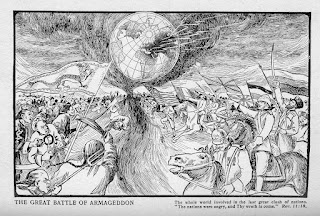


Some theologians say that Revelation was not meant as an exact prediction of the future. It is obvious, they point out, that the hallucinations of Revelation were just recycled from those of Ezekiel. It was meant, perhaps in secret code, as an encouragement for Christians to stand firm in the face of Roman persecution. But you call this shit encouragement? Encouragement, my ass. It stirs up hatred, not love and perseverance. How could Christians be encouraged by reading about rivers of blood and billows of pestilence? What kinds of twisted minds did people have.

This was exactly the same period of history as when the early church fathers were preaching that sex was fundamentally evil; it was necessary, but should only take place within marriage, and even then you have to make sure it was just for procreation, and to not enjoy it. Gentle sex within marriage was merely tolerable; meanwhile, literature that glorified blood and death was holy.

There is a moment of beauty in Revelation. Right at the end there is a heavenly city of peace. But even this city is utterly artificial. The beautiful river is actually a canal, and there is one tree. One tree, that’s all that remains of the natural world. If this is Heaven, count me out. I’d rather hang around and chat with Jesus.

Friday, June 12, 2015

New video: Darwin Discovers the Key to the book of Revelation

Just posted! Darwin discovers the key to the book of Revelation and almost--almost--becomes a fundamentalist preacher. See video here.

Thursday, September 1, 2011

Christianity and the Environment, Part 2

Even though many evangelical Christians criticized the 1967 paper by Lynn White, Jr. (see previous blog entry), he was right in his conclusion that conservative Christianity has encouraged a brutal conquest of nature. One reason is that the Bible is not a book. It is a collection of books, written by many people over many centuries, and it does not have a single coherent message. Most of the biblical books are themselves the product of editorial redaction from different primordial traditions. The first chapter of Genesis, correctly interpreted by White, presents a different view of creation from the second chapter, which was originally written by a different person. Each part of the Bible potentially contradicts every other part. An adherent of Christianity may choose to accept a Biblical image of conquering the Earth, or a Biblical image of taking care of it. It all depends on which passage is chosen. Adherents of Christianity, Judaism, or Islam can, however, force these passages into harmony, and in this way they can use the second chapter of Genesis to ameliorate the first.

White was right for another reason. Christian theologians have forced all the Biblical passages into harmony, and the climax of this harmonized Bible is the book of Revelation, also known as the Apocalypse. Revelation, the last book of the Bible, is the only example of an entire style of literature, popular in the Mediterranean world about 100 C.E., which is familiar to most modern readers. In this book, the entire biosphere of the Earth is destroyed during cosmic battles between good and evil, and those who are saved live in Heaven. The Heavenly City there described is the antithesis of biodiversity, and contains virtually nothing of the original creation. There is a river and a single tree. Everything else is gold and jewels—an utterly artificial environment. If this is, as about half of Americans believe, the future of the universe, what is the point of saving species and ecosystems? (See earlier blog entries for more on this idea.) For this reason also, if Christians are to participate in the rescue of the environment, they must look beyond the Bible and perhaps, as White suggests, emulate St. Francis.

The extreme popularity of apocalyptic Christianity meant that Christians, as a whole, were a feeble source of support for environmental protection. Their main passion was to support the politically conservative George W. Bush Administration, which rejected the evidence of global warming and paid little attention to environmental protection. In fact, after the end of the Bush administration, the full extent of conservative neglect for even the most basic environmental protection became obvious. The Minerals Management Service of the Department of the Interior was supposed to license fossil fuel extraction on federal lands with due consideration of the impact that this extraction would have on natural habitats. Instead, they gave licenses to corporations in return for bribes and sexual favors. When President Bush left the 2007 economic summit, he said, “Goodbye from the world’s biggest polluter,” making environmental ethics into what he considered to be a joke.

Edward O. Wilson, perhaps the world’s leading defender of biodiversity, wrote a book that was addressed to an unnamed Baptist minister. Wilson said that a conservative Christian could find common ground with even a secular humanist like himself by defending the Earth, which Wilson called the Creation. Wilson, however, wrote this book only after originally considering the Christian environmental movement to be a hopeless cause.

With the end of the Bush Administration and the disgrace of several leading Christian anti-environmentalists, a tide of opinion has turned towards Christian environmentalism. Despite this, many conservative Christians still consider the Earth to be unworthy of serious attention. They focus their attention instead on fighting against evolutionary science. When Edward O. Wilson visited Oklahoma in March 2009, a group of creationists disputed him about whether Charles Darwin did or did not believe in a Creator, and in the process Wilson’s impassioned plea for saving the Earth’s biodiversity was largely obscured. The view of the Earth that many conservative Christians have can be summarized in this way: “It’s okay to spit on it, to drive a truck over it, to spill oil on it, to chop it down, or to shoot it, so long as you don’t believe that it evolved!”

This essay is based on the entry “Environmental ethics” in my forthcoming Encyclopedia of Biodiversity.

Monday, August 1, 2011

What is Love? Don’t Read the Book of Revelation

What is love? Any Christian will tell you without hesitation that it is defined in the 13th chapter of the first letter of Paul to the church at Corinth. This is, indeed, a beautiful passage. By the way, Biblical scholars pretty much agree that I Corinthians (unlike some other New Testament epistles) was genuinely written by the Apostle Paul. And Jesus demonstrated love all the time—he was sensitive to the touch of a suffering woman, and he saved the life of another woman who was about to be stoned to death for something that a man did to her. The Apostle John said, God is love.

But if you read the book of Revelation, you will get a completely different picture. This is yet another reason that I consider Revelation, and the conservative Christians who swear devotion to it, to be so dangerous. As I explained in a previous entry, most of the book of Revelation is just one long series of plagues and woes, bringing destruction upon the Earth and unspeakable suffering on human beings.

I noticed an interesting thing about those plagues and sufferings. On at least two occasions, the writer said that, despite the sufferings, the people of the Earth did not repent and love God. So God sends another plague. In the end, it does not work, and God establishes his Heavenly City by force, populated apparently only by the 144,000 people who have never had sex.

Imagine, if you will, a man who beats his wife and children, insisting that they love him. When they do not, he beats them some more. Finally they are dead. I think we would all agree that this man (who sounds like some of the rednecks who live around me in Oklahoma, except that they seldom go as far as murder) has no clue about what love is, and is probably crazy. Well, this is exactly what God does to the human race in Revelation. Revelation makes God sound like a crazy maniac. Most religious people do not believe that this is what God is like, but it is the image that Revelation presents. It presents the image of a God who keeps kicking the shit out of the human race until we love him. And this is why Revelation is a dangerous book, and the conservative Christians who adhere to it are dangerous people. I have no problem with Christians who adhere to Jesus rather than to Revelation.

I will be exploring this idea in a new book, Last Tree Standing, which I will write when current publishing and other obligations allow me some time. Please share with me some of your insights.

Saturday, July 23, 2011

How Christianity is Destroying the Earth

The topic of why Christianity is wrong is of no mere academic interest. It is perhaps the most important topic in the world today. The majority of people in the United States adhere to a form of Christianity that leads, consciously and unconsciously, to the destruction of the Earth. And the United States is the leading consumer in the world; if we act destructively toward the Earth, it will be destroyed, and no bleeding-heart environmentalists in Norway can stop it.

I realized this as I began to read Bart Ehrman’s book from eight years ago—Lost Christianities. Ehrman is an excellent Biblical scholar, but I am an evolutionary scientist, so I read the first part of his book with different eyes than he used while writing it. I saw the evolution of Christianity as an example of cultural evolution—in particular, of one branch of Christianity that forced other branches into extinction, often violently, by decreeing them to be heretics. “Orthodox” Christianity suppressed the other branches, sometimes completely into extinction, but otherwise into such obscurity that only the luckiest of archaeological finds have revealed them. This is what happened when the church stopped being a haven for women and slaves and started turning into a political force with a hierarchy.

The “orthodox” Christianity that prevailed got to dictate which books would be in the Bible. There are lots of other gospels, epistles, acts, and apocalypses that they tried to destroy. But one of the books that they made sure was in the Bible was Revelation, written by somebody named John, whom most churchgoers assume was the Apostle John, though the author nowhere claims this to be the case.

It had been awhile since I had looked at Revelation, though I have read it carefully twice. Those previous times, however, I read it through the eyes of faith, assuming it to be divine revelation. This time I could see it for what it really was. Previously, I had tried my hardest to interpret it in a loving fashion. But now I could see the hatred that seethes from it. In a later entry, I will summarize it. But for now I just point out that it—presented in the form of a vision—is actually a nightmare of blood and gore and hatred. The author must have gotten some bad hash from Damascus.

First, you will not recognize the Jesus who is in Revelation. He is a conqueror, with a sword coming out of his mouth, and making the earth to apparently flow fathoms deep in human blood. Second, you will not recognize God the Creator of the Good Green Earth. Every few verses there is another disaster, both human and ecological—the Earth seems to get destroyed about fifteen times in that book. If one green sprig survives, it is sure to get pummeled and poisoned a few verses later. The disasters are concatenated: as soon as you think it is about over, another series erupts—within the Seventh Seal were seven trumpets, but within the seventh trumpet were three protracted woes, within which were crammed seven plagues. And so on. A cavalry of 200 million supernatural horses. People believe this stuff.

And at the end, when there is supposedly a heavenly city that takes over all of the universe, what do you have? A city consisting entirely of gold and jewels. The animals in that world are creepy monstrosities that look like Dr. Moreau invented them. And there is one tree—just one—left standing. This is the conservative Christian view of eternity—one in which everything that they claim God created has been destroyed and replaced with a total artificiality. You can bet your bottom ribosome that the “glassy sea” has no phytoplankton in it.

That is what conservative Christians want to have happen to the world—they look forward to God bringing plagues and destruction upon it, and then to have all of its biodiversity and greenness destroyed. Many Christians take a highly figurative interpretation of Revelation, and they are (as I was) frankly embarrassed by that book. But conservative Christians relish in the thought that environmental destruction will come upon Earth as part of a horrific suffering inflicted upon the human race. At least subconsciously, they will go along with and contribute to activities that will bring environmental destruction to pass.

And that is exactly why we need to discredit and disempower “Bible-believing Christians” in every way we can. If they actually believed in Jesus, the peaceful man who would go out on the hillsides and preach sermons about wildflowers, they might be a positive force. But they hate the Jesus of the Gospels. They revere only the Warlord of the Book of Revelation, and they want to do their part to make all of those ghastly images become reality.

I am developing these ideas into a book—Last Tree Standing: How Conservative Christianity is Destroying the Earth. Here is your chance to make comments that may help form the book, including comments that will prevent me from making errors that you may see in my ideas.