Showing posts with label Armageddon. Show all posts

Wednesday, January 5, 2022

From the Very Beginning

From the very beginning, Christianity has been a religion of bloodthirsty violence. 

Jesus was neither bloodthirsty nor violent. Some of his disciples wanted to be. Peter had a sword ready, but Jesus told him to put it away. Jesus said, “Those who live by the sword shall die by the sword.” What he meant was, don’t do it. Many modern conservative Christians would say, “Yee-haw! Let’s go die by the sword!”

Lots of evangelicals think they are willing to die for their faith, but what they actually mean is they are willing to kill for it.

For the first couple of centuries after Jesus’ death, there was little or nothing in writing about Jesus. The men who wrote the first gospels had, at best, second-hand access to information about him. Their writings reflected their beliefs and feelings more than those of Jesus.

Consider, for example, the gospel account of the trial of Jesus. According to this, the Jewish rabble in the streets called for Jesus to be crucified. And they said, Let his blood be upon us and upon our children.

There is no other historical corroboration (e.g., from Josephus) that any of them actually said this. This could have been nascent antisemitism that was already germinating within the church. It didn’t take too long before Christians were using this as an excuse for persecuting Jews.

But suppose that the rabble actually said this. This does not obligate God to do what they said. The idea that the rabble said Let his blood be upon us and on our children, and that this obligated God to allow the persecution of Jews throughout all subsequent history. This sounds as if God said, Oh, well, I guess this means I’d better let the Jews get persecuted, whether I want to or not. Poor little God, he had to let a rabble dictate the entire future of the world.

And the major proponents of this view are modern evangelical Christians. That is, modern fundamentalists actually give a street rabble power superior to God. I actually heard this on a radio broadcast from Rhema Bible Church in Tulsa, but they cannot be the only ones. It is blasphemy to elevate human ideas over God. Fundamentalists are blasphemers. This started very early in the history of the church.

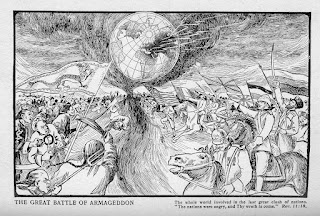
One of the latest books of the New Testament is the book of Revelation. It is the bloodiest, most gruesome book you could ever read. Fundamentalist Christians believe it is an exact prediction of what will happen in the End Times. They love this stuff. They cannot wait to watch God torture millions of people as they writhe in agony. Fundamentalists drool at the thought of the afflictions to come. And they have been doing so for a long time, at least since about 100 CE when Revelation was written. This image is from a 1917 Adventist book.


Some theologians say that Revelation was not meant as an exact prediction of the future. It is obvious, they point out, that the hallucinations of Revelation were just recycled from those of Ezekiel. It was meant, perhaps in secret code, as an encouragement for Christians to stand firm in the face of Roman persecution. But you call this shit encouragement? Encouragement, my ass. It stirs up hatred, not love and perseverance. How could Christians be encouraged by reading about rivers of blood and billows of pestilence? What kinds of twisted minds did people have.

This was exactly the same period of history as when the early church fathers were preaching that sex was fundamentally evil; it was necessary, but should only take place within marriage, and even then you have to make sure it was just for procreation, and to not enjoy it. Gentle sex within marriage was merely tolerable; meanwhile, literature that glorified blood and death was holy.

There is a moment of beauty in Revelation. Right at the end there is a heavenly city of peace. But even this city is utterly artificial. The beautiful river is actually a canal, and there is one tree. One tree, that’s all that remains of the natural world. If this is Heaven, count me out. I’d rather hang around and chat with Jesus.

Saturday, August 25, 2012

Well, If We Aren’t Christians, Then What Are We?


(Photo from Guardian.co.uk, 2008)

In the previous essay I explained by even Bible-believing “Christians,” much less agnostic “Christians” like me, cannot use the term Christian, since the far-right conservatives have defined the term to their satisfaction.

Well, then what term can moderate Christians, or agnostic followers of Jesus, use? I suggest “Bleeding Hearts.”

And why not? That is what the conservatives, especially the religious conservatives, already call us. They intend it as an insult. But maybe we should just embrace it. I remember a 60 Minutes interview of Studs Terkel back when I was a youth in the 1960s or 1970s. Mike Wallace or Morley Safer or somebody asked him what he thought of being called a Bleeding Heart. His answer was immediate and passionate: Terkel said that he was not offended by this term, because it referred to the bleeding heart of Jesus Christ, of which he was not ashamed.

Progressive Christians, and Christian agnostics, identify with the loving side of Jesus, as depicted in the gospels, which includes Jesus dying on the cross not as a theological technicality but pouring forth is life blood and love. This is what is meant by Bleeding Heart.

Conservative Christians identify mainly with the Jesus of Revelation, who rides a white horse and has a sword sticking out of his mouth. Conservative Christians look forward to the Battle of Armageddon in which the earth literally runs knee-deep in human blood. I am not making this up. I heard on Christian radio (the Bot Radio Network back about 2004). Their main, and almost exclusive, focus is on the Apocalypse, and their message is, Bring it on! Some of them literally—I know from firsthand accounts—think Barack Obama is the Antichrist of Revelation.

I think we should just call ourselves Bleeding Hearts, putting ourselves into clear opposition to the “Christians” who look forward to bleeding battlefields.

Sunday, March 11, 2012

The Armageddon Mindset

According to a 1999 poll, which is the most recent data I could find, 40 percent of Americans believe the world will end in a battle of Armageddon. About 45 percent of these people believe that the Antichrist is on the Earth now, and that Armageddon will happen during their lifetimes. This means that 18 percent of Americans believe that there is no future to the world past the end of their lifetimes. This is a large enough segment of the population that it is politically important, especially within the Republican Party.

Two things are impossible if you really believe that the world is ending soon. First, it is impossible to take any serious action about any environmental issue. We environmentalists can explain all day long that environmental destruction, particularly global warming, will prove disastrous to people in the future—in fact, in the near future. People who believe there is no future find such concerns literally incomprehensible. They may, in principle, assert that God is the Creator and we have no right to destroy the creation, but they simply cannot convince themselves of this, no matter how hard they try.

Second, it is impossible to take any serious action about fiscal responsibility. People with the Armageddon mindset overwhelmingly want the government to spend less money. But the reason is not in order for the government to have a sustainable future—since there will be no future—but in order to not have to pay taxes. Evidence for this is that these people call for unlimited spending on defense, which just might hurry up the Armageddon that they anticipate. They talk about the future of their children—a future they believe will not exist on Earth—and may try hard to believe it, but they cannot convince themselves of this, no matter how hard they try.

The Armageddon mindset is totally incompatible with any kind of scientific thought. This website is about ecology and evolution, about the effects of evolution on humans and the relationship between humans and the global ecosystem. The Armageddon mindset cannot be touched by reason or evidence, or perhaps even by direct experience. The only thing that scientists or scientifically-minded citizens can do is to write off the Armageddon folks and not even try to talk with them. Unfortunately, they are a major political force.

What should thoughtful people do about this, if anything? Please post your responses in the comment box below if your browser shows it; otherwise send comments to abutilongr@gmail.com. I hope you can enlighten me with some uplifting thoughts. This essay will appear soon on my website.

Monday, May 17, 2010

A Graphic Warning


Fundamentalists (Christians, maybe Muslims too) get carried away by their own imaginations. They think they have figured out the key to Biblical prophecies, and they rush forward convinced of the inerrancy of their own interpretations. How many of you remember Edgar Whisenant’s “88 Reasons Jesus Will Return in 1988”?

I just wanted to publicize this drawing, which appeared in an Adventist book in 1917, entitled, Our Day in the Light of Prophecy. As you can tell from the date, the author was expecting World War I (still at the time called The Great War) would be the final conflict. He was so sure that Imperial Russia and the European Allies would be fighting (on horses) against China. Before the year was out, Imperial Russia was gone.

Fundamentalists predicted that the Iraq War was the beginning of the final conflict. (Perhaps some of them were in the Bush Administration, which originally called the war “Operation Infinite Justice” before they changed it to “Operation Iraqi Freedom.”) Being limited to only occasional contact with fundamentalists, I cannot say what they think right now.

The graphic warning is not just to fundamentalists but to any of us who think we can accurately predict the future in all but the most general sense. We have a good scientific understanding of the general course of global warming, but the specific geopolitical consequences are all the more frightening because they are not precisely predictable.