Thursday, March 31, 2022

Evangelical Religion and Hypnosis


The following is a creepy story about religion and implanted memories. It makes me shudder because I used to be in a fundamentalist church that did not do anything like this, but could have. I cringe to think how close I came to a fundamentalist psychological hell, the way Paul Ingram did.

In 1988, Paul Ingram, a local Republican leader in Washington state, was accused by his daughters of sexual abuse, including ritual satanic abuse, over the course of several years. No evidence has ever been found that these acts of abuse ever happened. Despite this, the daughters’ testimony was accepted as evidence, and Ingram was convicted and given a twenty-year sentence. Ingram pled guilty to the charges. Subsequent research makes it clear that these events never occurred. The memories were implanted, through deliberate or inadvertent hypnotism, by the fundamentalist church to which the family belonged. An implanted memory can seem just as real as a true memory. A church seminar leader apparently asked one daughter, Ericka, to try to remember if she had been abused. This was enough for her to “remember” that it had happened. Then the memory was implanted in Paul.

This is what religion can do, especially the fundamentalist variety that believes that Satan is everywhere and can trick you into doing things that you would normally not even want to do—that is, unless you join and give money to a fundamentalist church. The Satan hypothesis was enough to send an accusation that would have gone nowhere in a mainstream church over the edge into an ever growing series of accusations in a fundamentalist church.

It kept growing. Paul Ingram was accused of killing 65 babies in satanic rituals. And he believed that he had done so. Needless to say, no evidence was ever found. No graves. Of course, the fundamentalist church could always claim that Satan had erased the evidence. By the time Ingram was released from prison, before the end of his term, he may not have been entirely convinced of his own innocence.

Fundamentalist churches use psychological manipulation which can go to absurd lengths and destroy people’s lives. They can do this because the churches believe in a Satan who can manufacture or erase evidence. This is another example of trance logic, which is a characteristic  of hypnotism.

In addition, psychoanalysts were happy to use three-quarters of a million dollars of taxpayer money to “recover” these “hidden” memories. Fundamentalism uses psychological manipulation and implanted memories to oppress people and destroy their lives, and some unethical psychologists are willing to make money off of this phenomenon.

Saturday, March 19, 2022

Everywhere You Look: Fundamentalist Megachurch Lack of Ethics

There are so many examples of evangelical Christian megachurches and blatant lapses of ethics that one hardly knows where to begin. I’m not beginning; I have no plan to do an investigative series, but to simply post one story among many. This story illustrates perfectly how evangelical Christianity is using psychological manipulation to get money from people. I can only wonder if it has anything else to offer. If they so easily lie about their business dealings, maybe they are lying about Jesus also.

This story is about Mark Driscoll, a televangelist pastor at Seattle’s Mars Hill Church. For many years and in many ways he demonstrated not only a total lack of ethics but psychological manipulation to get rich and famous. You can read the details here.

Driscoll wrote a book about how to have a wonderful marriage. Then his church paid a quarter million dollars to buy 11,000 copies of this book, thus boosting it to the New York Times best seller list. This gave Driscoll the kind of publishing fame that the rest of us can only dream of having. Then he used this fame to negotiate a multi-book deal with Tyndale House, a Christianoid publisher. (I just invented this term. Christianoid means using Christian words and images to appear Christian for purposes of fame, fortune, or manipulation.) When news broke of what Driscoll had done, Tyndale House defended him. Clearly, at least this Christianoid publisher has no interest in professional ethics or honesty. I cannot help but wonder if the way to have a wonderful marriage is to pay your spouse a quarter of a million dollars.

Of course, Driscoll got a lot of radio publicity too. As a result of Driscoll’s lack of ethics, one assistant radio producer got fed up with it and resigned. She cited an “evangelical celebrity machine.” Maybe that is what the evangelical gospel is all about: people following religious celebrities for no better reasons than they follow entertainment celebrities. Maybe evangelical Christianity is merely a form of entertainment.

There have also been several charges of plagiarism against Driscoll. Not just a sentence here or there, but large passages of his writings are stolen, maybe a word changed here or there, from authors who could only dream of Driscoll’s level of fame. Despite this, many evangelical leaders continued to defend him. The cumulative effect of Driscoll’s ethical lapses eventually caused Mars Hill Church to close. The last sermon was delivered by another famous evangelical preacher, Rick Warren, who told everyone that God had done wonderful things through Driscoll. This makes me wonder if Rick Warren sees no problem with unethical evangelicalism.


Wednesday, January 5, 2022

From the Very Beginning

From the very beginning, Christianity has been a religion of bloodthirsty violence. 

Jesus was neither bloodthirsty nor violent. Some of his disciples wanted to be. Peter had a sword ready, but Jesus told him to put it away. Jesus said, “Those who live by the sword shall die by the sword.” What he meant was, don’t do it. Many modern conservative Christians would say, “Yee-haw! Let’s go die by the sword!”

Lots of evangelicals think they are willing to die for their faith, but what they actually mean is they are willing to kill for it.

For the first couple of centuries after Jesus’ death, there was little or nothing in writing about Jesus. The men who wrote the first gospels had, at best, second-hand access to information about him. Their writings reflected their beliefs and feelings more than those of Jesus.

Consider, for example, the gospel account of the trial of Jesus. According to this, the Jewish rabble in the streets called for Jesus to be crucified. And they said, Let his blood be upon us and upon our children.

There is no other historical corroboration (e.g., from Josephus) that any of them actually said this. This could have been nascent antisemitism that was already germinating within the church. It didn’t take too long before Christians were using this as an excuse for persecuting Jews.

But suppose that the rabble actually said this. This does not obligate God to do what they said. The idea that the rabble said Let his blood be upon us and on our children, and that this obligated God to allow the persecution of Jews throughout all subsequent history. This sounds as if God said, Oh, well, I guess this means I’d better let the Jews get persecuted, whether I want to or not. Poor little God, he had to let a rabble dictate the entire future of the world.

And the major proponents of this view are modern evangelical Christians. That is, modern fundamentalists actually give a street rabble power superior to God. I actually heard this on a radio broadcast from Rhema Bible Church in Tulsa, but they cannot be the only ones. It is blasphemy to elevate human ideas over God. Fundamentalists are blasphemers. This started very early in the history of the church.

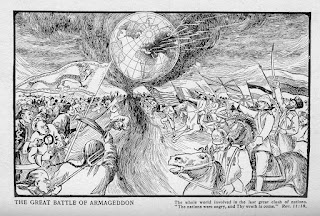
One of the latest books of the New Testament is the book of Revelation. It is the bloodiest, most gruesome book you could ever read. Fundamentalist Christians believe it is an exact prediction of what will happen in the End Times. They love this stuff. They cannot wait to watch God torture millions of people as they writhe in agony. Fundamentalists drool at the thought of the afflictions to come. And they have been doing so for a long time, at least since about 100 CE when Revelation was written. This image is from a 1917 Adventist book.


Some theologians say that Revelation was not meant as an exact prediction of the future. It is obvious, they point out, that the hallucinations of Revelation were just recycled from those of Ezekiel. It was meant, perhaps in secret code, as an encouragement for Christians to stand firm in the face of Roman persecution. But you call this shit encouragement? Encouragement, my ass. It stirs up hatred, not love and perseverance. How could Christians be encouraged by reading about rivers of blood and billows of pestilence? What kinds of twisted minds did people have.

This was exactly the same period of history as when the early church fathers were preaching that sex was fundamentally evil; it was necessary, but should only take place within marriage, and even then you have to make sure it was just for procreation, and to not enjoy it. Gentle sex within marriage was merely tolerable; meanwhile, literature that glorified blood and death was holy.

There is a moment of beauty in Revelation. Right at the end there is a heavenly city of peace. But even this city is utterly artificial. The beautiful river is actually a canal, and there is one tree. One tree, that’s all that remains of the natural world. If this is Heaven, count me out. I’d rather hang around and chat with Jesus.

Tuesday, December 21, 2021

No Such Thing As Evidence

One thing I have pretty much given up on is trying to convince religiously-based conservatives of anything.

I spent a lot of time, in earlier years, presenting clear and simple evidence for the science of evolution. I think my books were pretty good in this regard. But I was not trying to convince creationists. They know they are wrong, and creationism is just a way of them influencing other people to be their followers.

I have also spent a lot of time presenting clear and simple evidence for the science of global warming. I briefly thought I might convince some “climate skeptics” that they were wrong. But they already know they are wrong. “Climate skepticism” is just their way to influence other people to be their followers.

More recently, millions of people refuse to believe that there is any such thing as the covid pandemic. Some of them run state governments. Here in Oklahoma, the Republicans have repeatedly proclaimed that a mask mandate is just as bad as Hitler’s Holocaust. They ignore all medical evidence.

To religious conservatives, there is no such thing as externally-verifiable truth. This became abundantly clear during the Trump years. Trump’s followers believed, and still believe, that He won the election of 2020. Their evidence? None, other than the fact that He says so. I deliberately gave the God-capitalization to the pronoun.

The religious conservatives have always been half-hearted in their beliefs. When the preacher Rice Broocks visited the University of Illinois, before he became a cofounder of a major church, he publicized that he was going to speak about creationism, but he asked the audience to release him from this topic, so that he could talk more about all the miraculous healing that God was doing through his hands. When I contacted the leader of the Heartland Institute, asking him for evidence regarding some of his claims that global warming was a hoax, his personal email response to me was, “Snore.” I’m not sure what that means, other than that he has no time to answer any questions. He was too busy hoodwinking people into believing him.

But with the covid epidemic and the Trump campaign, religious conservatives have abandoned all pretense at presenting evidence. The total absence of evidence does not show them they are wrong but is simply proof that Satan is so good at hiding their evidence that nobody can see any of it. I heard a preacher claim, a couple of months ago, that Joe Biden stole 41 million votes. Where is the evidence for this? None. To them, the absence of evidence is evidence that they are right.

And not only right, but the very rightness of God. Religious conservatives are blasphemers, who believe that Donald Trump creates truth by saying it. Here in Oklahoma, I see their flags and stickers all over the place. And they have stockpiles of automatic weapons. They do not hide this fact.

There is no point in trying to convince anyone on the political right. They already consider themselves to be incapable of error, as inerrant as God Himself.

When I stood in line last summer at a state agency, a Trumper started telling us that the covid epidemic was caused by dirty Mexicans coming over the border, or else (he was unclear) Biden invented it as an excuse to take away our freedoms. I had to struggle to suppress my desire to raise my voice. He insulted me by saying that my extensive studies, leading to a Ph.D. in biology, were less important than his wild guesses.

Further evidence of their blasphemy is that they not only despise anyone who does not believe them, but they particularly despise their fellow Republicans. To Trumpers, Biden (and especially that colored woman who is his vice president) is an infidel, but moderate Republicans like Liz Cheney are heretics. Heretics are always worse than infidels. Shi’a extremists hate Sunnis worse than they hate Christians.

I continue to write about evolution and global warming, not to try to convince right-wing blasphemers, but to educate people who already know the truth but appreciate discovering new evidence. Only the people who already know about evolution and global warming and the pandemic and that Trump lost, only these people, are delighted to learn new things.

And as a science educator and writer I really enjoy helping sincere people understand the world better, and that is my only goal and the only reward. In a way it is a relief to not have the burden of convincing anyone.


Sunday, December 12, 2021

Was Love Born in a Manger?

A church sign I saw out in the country in Oklahoma recently read, “Love Was Born in a Manger.” I will briefly explain why this is wrong.

Most of my life, devoutly Christian, I was deeply moved, almost suffocated, by my belief that Jesus represented the manifestation of God’s love to humankind. I was wrong. The stories of Jesus are wonderful—certainly, in my mind, Jesus represents some of the finest of human love—and I wish I could still believe that love was born in a manger at Christmas.

But I will now explain why this belief is wrong.

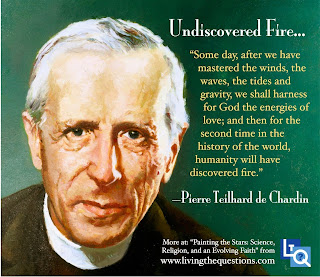
The statement implies that, without Jesus having been born, or foreordained from the beginning of Creation to be born, then there would be no love. But it is quite clear that love evolved. I do not mean  in some vague way as Pierre Teilhard de Chardin wrote about decades ago. I mean that love evolved by means of natural selection.


I am talking about altruism. Love promotes altruism which promotes fitness. Not always, but often. To love your offspring and, to a lesser extent, your relatives increases fitness through inclusive fitness. To love your friends increases fitness through direct reciprocity. To have a reputation for being kind and generous increases fitness through indirect reciprocity. Natural selection favors whatever increases our fitness. Often this is hatred, but often (perhaps even more often) it is love. Natural selection gave us the instinct of love. The evidence is that it feels so good. We need food; natural selection favored millions of years of animals who, when hungry, love the taste of food. We need water; natural selection favored millions of years of animals who, when thirsty, love water. Love is an appetite, just as much as sex, food, and water. Whether we decide to use the instinct of love or not is up to each of us individually.

There is another problem with the belief that Jesus is the origin of all love. It implies that those of us who do not accept the doctrines about Jesus (however much we may love Him) do not really love other people, the natural world, or God. We are either faking it or are totally deluded. What I experience, when I feel love for Jesus or for other people or for the creation, is not genuine, according to this view.

But I know what I am thinking. I know for a fact that I am not faking it. Billions of people who are not doctrinal Christians love people, the natural world, and God very passionately. Some are lying, but we can’t all be lying. I cannot speak for anyone else, but it would be the height of arrogance to claim that I am the only non-doctrinally-Christian person who sincerely loves other people. Many doctrinal Christians would claim that those of us who reject their doctrines might sincerely believe we are sincere, but it is in fact a delusion. I am not deluded. The burden of proof is on doctrinal Christians who claim that all who reject their doctrines are either liars or lunatics.

If, in fact, love does not exist apart from a doctrinal Jesus, then it must come from somewhere else. It must be part of human nature. And, as I wrote above, I believe that evolution put it there. Love is a basic instinct.

Merry Christmas, y’all, and though you may not think it possible, I believe Merry Christmas.

Saturday, November 20, 2021

Who Was This Guy Anyway?

I ran across a couple of articles written in 1987 and 1989 by some guy who thought not only that the world is ruled by a good God, but that he could prove it! How weird is that?

Lots of people believe that there is a good God, somewhere, but that this God does not do very much to help the world except maybe in some special once-in-a-while miracles, but that the universe pretty much operates as if there is no God. That is, they are not atheists. It’s just that God is pretty much irrelevant to the way the world works. But this guy saw the goodness of God operating all around him. I’ve got to hand it to him; he amassed a lot of disconnected information from his voluminous knowledge into a big steaming pile of assertions. He was apparently Piled higher and Deeper.

To his credit, this author spent his entire first article admitting that the natural world did not, in fact, reflect the God of love. Even the things that appear peaceful and beautiful actually resulted (by evolution) and continue to function (by ecology) by means of selfish processes. Pretty flowers, for example, are selfishly efficient at attracting pollinators, and singing birds are selfishly establishing territory and attracting mates. He admits, then, that the way for a Christian to look at what nature tells us about God is to look at it figuratively (as Jesus did in parables). The problem the author overlooks, however, is that the figure depends on the observer, resulting in circular reasoning about a God of love. This circular reasoning deliberately omits many important things. Jesus said, If God so feeds the birds of the air; but what about the ones God doesn’t feed, and they die?

Then, in his second article, the author describes a “pervasive theme” in the natural world and in human history, when viewed as one might view a piece of literature: Blessings emerge from adversity. I’m sure you can think of lots of examples; the author drew together a mixed grab-bag of them. An ape, or what the Bible calls “dust of the ground,” became capable of understanding the world. How’s that for a blessing from privation? He cites lots of Bible examples of God elevating the humble to positions of prominence, such as Joseph, David, the prophets, in fact the whole nation of Israel and the whole church. Our own spiritual development, he says, depends on our optimistic response to challenges.

Then he turns to the natural world for lots more examples. Some of the greatest evolutionary innovations occurred in response to natural disasters. Right from the start! Oxygen in the air was a primordial poison, but the cells that could not just tolerate it but use it became the ancestors of nearly all life forms now on the Earth. And on and on for billions of years. Mammals spent more millions of years skulking in the shadow of dinosaurs than as the dominant animal life forms as they are today, from our perspective. Altruism has evolved. Parasitism evolves into parasitism. He even points out that rates of extinction in the fossil record have been declining, a point he got from reading Stephen Jay Gould. Even the acclimatization of individual organisms to changes in their environments (which is not evolution), and ecological succession (which is not evolution either), are examples of life proliferating in adversity. He ends the second article with a quote from a largely-forgotten Scottish botanist who looked at the world the same way.

With all of these examples, how could the pattern not be true? But the author could not say that the pattern was miraculous. The best he could manage was to say that blessings out of adversity was God’s “activity” in nature. Like, how is that any different?

Of course blessings can arise from adversity. But we only hear about the successful ones. We hear the hero stories of people who confronted terrible suffering, and not only persisted but lived to tell about it. We do not hear from the ones that got killed because they are dead. We hear the story of Malala Yousafzai, shot by Islamic terrorists who attacked a girls’ school and who worked for peace, receiving a Nobel Prize (this happened after the articles were published); we do not hear the stories of the girls who died.

Of course blessings can arise from adversity. Adversity creates opportunity, and some organisms are able to capitalize on it. A forest fire releases nutrients from dead plant matter and allows an influx of sunlight. Too bad about those trees that died, but the wildflowers bloom like crazy. But that is what wildflowers do.

This author’s view is a beautiful artistic view of the world, but it tells us nothing, nothing at all, about God. The author was, and is, happy, even if this vision is a fantasy.

As you have figured out, the author was myself, back in my evangelical days. Though I can no longer assert the actual truth of these statements, I really enjoy thinking about the things about the natural and human world that I like, especially when I need some diversion from the things I don’t like.

The articles appeared in the September 1987 and March 1989 issues of Perspectives on Science and Christian Faith.

Friday, October 22, 2021

A Child’s Machiavelli: A Primer on Power


These quotes are from a book by the title above. Once you have read them, you might not need to read the original. To what extent The Prince was right or not, I will not comment.


  • It’s best to have a family with a famous name ‘cos then you’ll automatically impress people and become really popular.
  • If you want to take over some place, don’t forget to kill not just the boss, but also all his kids!
  • Either be really nice to people or kill’em. If you don’t kill’em and you’re not so nice, then they’re gonna come after you.
  • If you just took over some place, raise everybody’s allowance. Then people will think you really like ‘em, and you can do whatever you want to ‘em for a little while.
  • If you help make someone Big, watch out. They’re gonna wanna get rid of you so everyone thinks they did it alone.
  • It’s easy to take over some place with a really strong Chief. Everyone’s used to being bossed around all the time, so when you get rid of him, people’re barely gonna notice.
  • If you wanna take over some place where the people could decide for themselves, you have to destroy everything.
  •  Never be afraid to beat someone up if you have to. First, try to talk ‘em into listening, but just in case, you know what to do!
  • The hardest job you can ever do is try to make things better for the Little Guys. The Big Guys are gonna hate your guts. And the Little Guys will be afraid to open their mouths.
  • People always think Bosses are bad news, so when you surprise ‘em with your niceness, they’ll be so happy, they’ll totally turn into your slaves!
  • Try to make everyone you know totally dependent on you, then you don’t have to worry so much that they’re gonna try to get rid of you.
  • When you take over some place, kill off everyone who’s against you, pronto, then act really nice to everyone left.
  • A gun is a man’s best friend.
  • Only give things away when people are watching. If you wanna give presents to people, make sure it’s other people’s stuff.
  • If you’re not a Boss but you wanna be one, make sure you trick everyone into thinking you’re a really generous guy.
  • Everyone says you should be nice, but no one really is, so if you do what you should and be nice all the time, you’re probably gonna get screwed.
  • You can do anything to people. As long as you don’t steal their girlfriends, they’re never really gonna hate you.
  • You’re better off having people scared of you than liking you. Now, it’s okay if people are scared of you. Just make sure they don’t hate you.
  • Be really nice to your closest underlings. Make them love you by giving them lots of presents.
  • If somebody’s got to hate you, make sure it’s a bunch of weaklings with no money.
  • Don’t keep your promises if there’s no reason to anymore—nobody else does.
  • Have five best friends who tell you what they really think, but only when you ask.